

Benedict's Law is Coming: Is Your School Ready for September 2026?
As school leaders, educators, and trustees head into the summer break, safeguarding is undoubtedly at the top of the priority list. But this year, a major legislative shift demands immediate attention.
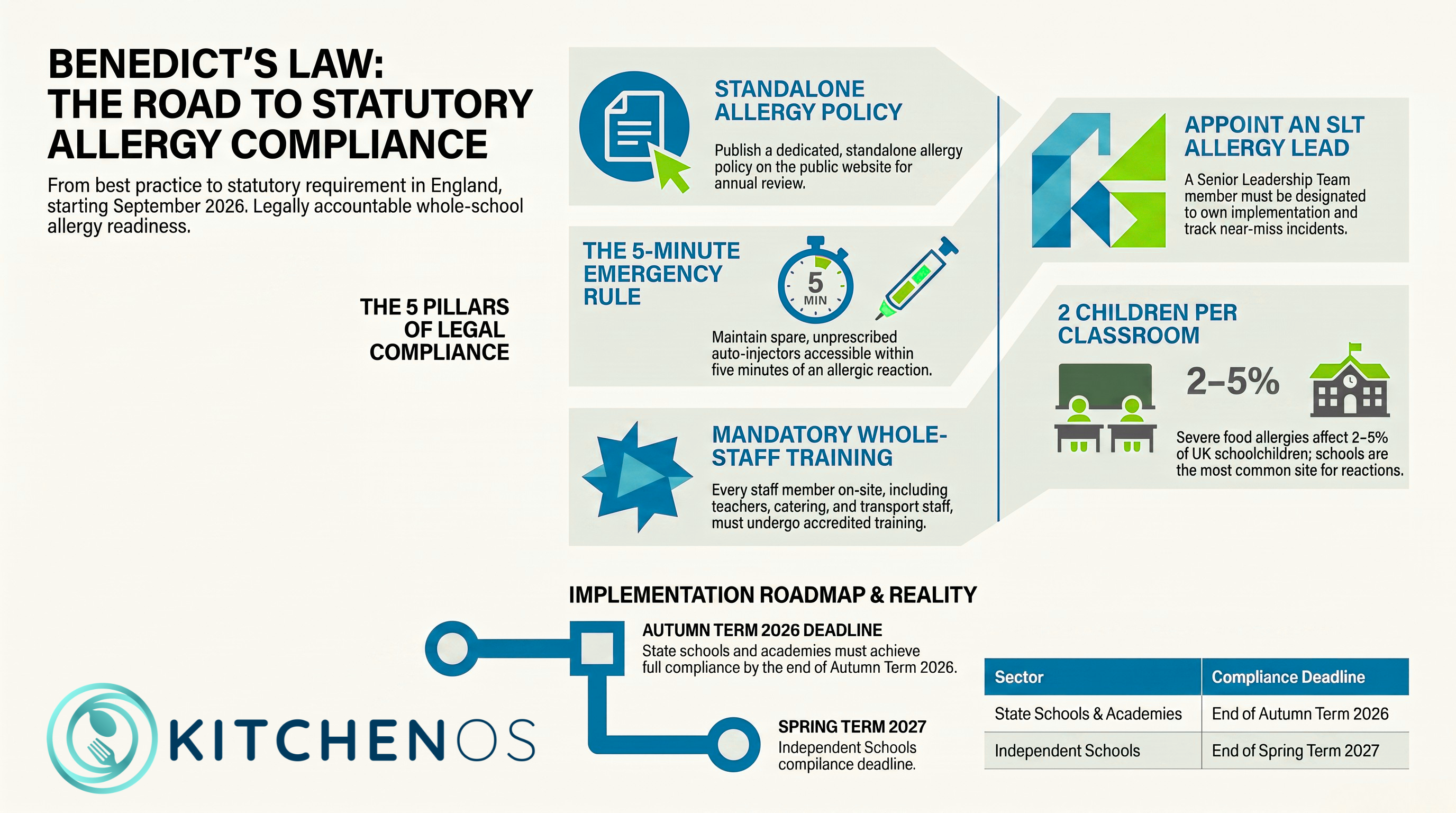
Starting September 2026, allergy management in England will officially move from a recommended "best practice" model to a mandatory statutory requirement. Known as Benedict's Law, this landmark legislation removes the historical "postcode lottery" of pupil safety and holds school leaders legally accountable for the allergy readiness of their environments.
Here is what Benedict's Law means for your school, academy, or multi-academy trust (MAT), and the exact steps you need to take to ensure compliance before the autumn term kicks off.
The Heartbreaking Story Behind the Legislation
Benedict's Law is named in memory of five-year-old Benedict Blythe, who tragically suffered a fatal anaphylactic shock at school in 2021 after being mistakenly given milk — an allergen the school was well aware he had.
Following relentless campaigning by the Benedict Blythe Foundation, Natasha's Foundation, and the wider medical community, the UK government passed the mandate in February 2026. The hard truth is that severe food allergies now affect roughly 2–5% of UK schoolchildren — translating to roughly two children in every single classroom. Because schools are the most common location for severe, first-time allergic reactions outside the home, passive compliance is no longer an option.
The 5 Pillars of Compliance
Benedict's Law requires a complete overhaul of how your setting handles allergens, moves away from isolated "first aider" reliance, and introduces a whole-school approach.
To be compliant by September 2026, your school must implement these five core changes:
1. A Standalone Allergy Policy
You can no longer fold your allergy procedures into a generic "Supporting Pupils with Medical Conditions" document. Schools must publish a dedicated, standalone Allergy Policy on their public website. It must outline clear risk mitigation, emergency response workflows, and be reviewed annually.
2. Mandatory, Whole-Staff Training
Allergy safety is no longer just the job of the designated school nurse or first aider. Every single staff member likely to be on-site at the same time as children must undergo accredited allergy and anaphylaxis training. This includes:
- Teachers and Teaching Assistants
- Catering and lunchtime staff
- Administrative, caretaking, and cleaning staff
- Minibus drivers and after-school club leaders
3. Spare Emergency Adrenaline Auto-Injectors (AAIs)
Schools are now legally required to purchase and maintain a backup stock of unprescribed, spare Adrenaline Auto-Injectors (such as EpiPens or Jext). These are critical safeguards for situations where a pupil's own device is broken or expired, or if a child suffers a severe first-time reaction without a previous diagnosis. Furthermore, the law states emergency AAIs must be accessible enough to be administered within 5 minutes of a reaction.
4. Robust Individual Healthcare Plans (IHPs)
Every child with an allergy must have a meticulously updated Individual Healthcare Plan or Allergy Action Plan. Crucially, Benedict's Law dictates that a formal clinical diagnosis is not required for a child to receive an IHP — if a parent reports an allergy that impacts the child's school day or poses a risk of harm, the school must put a plan in place.
5. Inclusion and Near-Miss Reporting
The law explicitly targets the social impact of allergies, requiring schools to proactively map out how children with allergies will be safely and fully included in school trips, mealtimes, and celebrations without being isolated. Additionally, schools must appoint a Senior Leadership Team (SLT) lead for allergy safety to ensure all "near-misses" and incidents are formally logged and reviewed to prevent future lapses.
Action Plan: What School Leaders Must Do Right Now
- Appoint Your Allergy Lead — Immediate. Designate a member of your Senior Leadership Team (SLT) to own the implementation, monitor tracking, and spearhead the compliance strategy.
- Draft and Publish the Policy — Before September Term. Separate your allergy protocols into a dedicated, standalone policy document. Draft Individual Healthcare Plans (IHPs) for every affected student, ensuring parental sign-off.
- Audit and Procure Emergency AAIs — Before September Term. Review the physical layout of your school. Calculate how many spare emergency auto-injectors you need to ensure a device can reach any classroom or playground within 5 minutes. Purchase these through trusted medical suppliers.
- Roll Out Mandatory Whole-Staff Training — Autumn Term 2026 Deadline. Coordinate a 1-hour accredited training block for all staff. Note that platforms like Allergy School (by Natasha's Foundation) provide Department for Education-endorsed, fully free accredited training modules to help schools meet this hurdle quickly.
A Note on Deadlines
While state sector schools and academies are expected to achieve full compliance by the end of the Autumn Term 2026, independent schools have until the end of the Spring Term 2027 to meet these requirements. However, starting the integration process now ensures zero gaps in your safeguarding net.
Benedict's Law is more than an administrative checklist; it is a vital, life-saving cultural shift. By equipping every adult in our buildings with the confidence, knowledge, and tools to act within those crucial first five minutes, we can make sure our classrooms remain spaces of safety, inclusion, and care.
Kitchen OS already helps school catering teams meet exactly this kind of scrutiny. AllerQ puts instant, always-current allergen information in front of every student and staff member via QR code, while Food Safe System keeps the underlying compliance records — training logs, checklists, and audit trails — organised and inspection-ready.
Getting ahead of Benedict's Law before September doesn't have to mean building a new system from scratch. See how Kitchen OS supports schools or get in touch to talk through what compliance looks like for your setting.
Resources
- Download the Benedict's Law infographic (PNG) — a one-page summary of the 5 pillars of compliance and the implementation roadmap.
- Download the Kitchen OS Compliance Tracker (XLSX) — a spreadsheet to help your school log policy status, staff training, AAI stock, and IHPs ahead of the deadline.